
Gyms put more strain on indoor air than almost any other type of building. Dozens of people breathing hard in one room, chalk dust in the lifting area, disinfectant sprayed on equipment all day, and often a studio with no windows at all.
Members come to get healthier but if the ventilation can’t keep up, they’re breathing stale, particle heavy air while their lungs are working at full capacity.
This guide explains how professional testing works in the UK, what it costs, what the law actually requires, and what to do with the results.
Why Gym Air Gets Worse than Office Air
When you exercise, your breathing rate can climb several times above resting level. You’re pulling far more air into your lungs and far more of whatever is in it.
Research on particle deposition shows the amount reaching your lungs roughly doubles between rest and intense exercise, so a pollution level that’s unremarkable at a desk delivers a much bigger dose during a spin class.
At the same time, the gym itself is generating pollutants:
- Carbon dioxide from everyone breathing hard the clearest sign ventilation isn’t keeping up
- Particulate matter (PM2.5 and PM10) from chalk, rubber flooring, and dust kicked up off mats by foot traffic
- VOCs and formaldehyde from disinfectant sprays, air fresheners, new flooring and equipment off-gassing
- Humidity and mould risk in changing rooms, and chloramines if there’s a pool
- Bioaerosols — exhaled droplets, which increase sharply during hard exercise in a crowded studio
The combination is what makes gyms unusual. It’s not one problem, it’s five happening at once in the same building.
What UK law actually requires
This is where most articles get vague, so here’s the plain version.
The Workplace (Health, Safety and Welfare) Regulations 1992 require every workplace gyms included to have effective and suitable ventilation with a sufficient quantity of fresh air.
That’s a legal duty to your staff, and by extension it shapes the environment your members train in.
COSHH applies where cleaning chemicals and disinfectants are used, which in a gym is constantly. Building Regulations Part F sets ventilation requirements for new builds and major refurbishments.
And if you have a café or kitchen on site, BESA TR19 Grease governs extract ductwork cleaning grease build up is a leading cause of commercial fires.
None of these say “you must test your air annually.” But if a member or employee raises a complaint, or if the HSE or your local environmental health team asks how you know your ventilation is adequate, test data is the only real answer. Without it, you’re relying on the fact that nobody has complained yet.
What indoor air quality testing for gyms actually involves
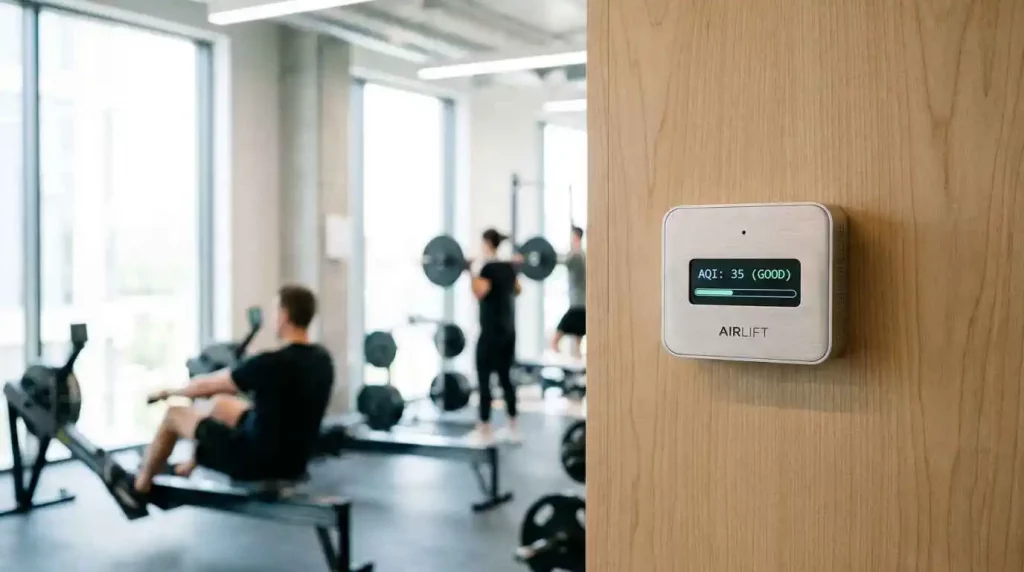
Here’s the part the sensor companies skip. A professional test isn’t someone waving a handheld gadget around for ten minutes it’s a structured survey designed to capture how your building behaves under real conditions.
Indoor air quality testing for gyms typically runs like this:
| Stage | What happens | Typical timing |
|---|---|---|
| 1. Survey design | We agree which areas to test — gym floor, studios, changing rooms, reception — and when, based on your busiest sessions | Before the visit |
| 2. On-site monitoring | Calibrated equipment records CO₂, PM2.5, PM10, VOCs, temperature and humidity across peak and off-peak periods | 24 hours to 7 days |
| 3. Ventilation check | Airflow rates measured and compared against what the building was designed to deliver | Same visit |
| 4. Analysis | Results assessed against CIBSE, Part F and WHO guideline values | 1–2 weeks |
| 5. Report | Findings by area, where limits were exceeded and when, plus prioritised recommendations | With analysis |
The timing point matters more than anything else here. A test carried out at 11am on a Tuesday will show you a healthy building. The same room at 6:30pm during a full class can look completely different. Any survey that doesn’t cover your peak occupancy isn’t telling you much.
What the numbers mean
You don’t need to be an engineer to read a report, but it helps to know what the key figures are pointing at.
| Measurement | Good | Needs attention | What it tells you |
|---|---|---|---|
| CO₂ | Under 1,000 ppm | Over 1,500 ppm | How much fresh air is reaching the room |
| PM2.5 | Under 15 µg/m³ | Over 35 µg/m³ | Fine particles from chalk, dust and outdoor air |
| Relative humidity | 40–60% | Under 30% or over 70% | Comfort, mould risk and airway irritation |
| VOCs | Low, stable readings | Sustained spikes after cleaning | Chemical load from products and off-gassing |
A useful way to read a report: CO₂ tells you whether your ventilation is sized correctly for how busy you actually are. Particulates tell you whether cleaning and floor management are working. VOCs usually point straight at your cleaning routine.
Signs your gym needs testing now
You don’t always need data to know something’s off. Common warning signs include a stale or sweaty smell that never quite clears between classes, condensation on mirrors and windows at normal temperatures, members mentioning headaches or unusual tiredness after sessions, visible dust in sunlight near the free weights, and staff complaints in the same rooms week after week.
If two or more of those sound familiar, a survey will usually find something worth fixing. The same applies if you’ve recently refurbished, changed your opening hours, or significantly increased class sizes all three change the ventilation demand on a building that was designed for something else.
A real project example
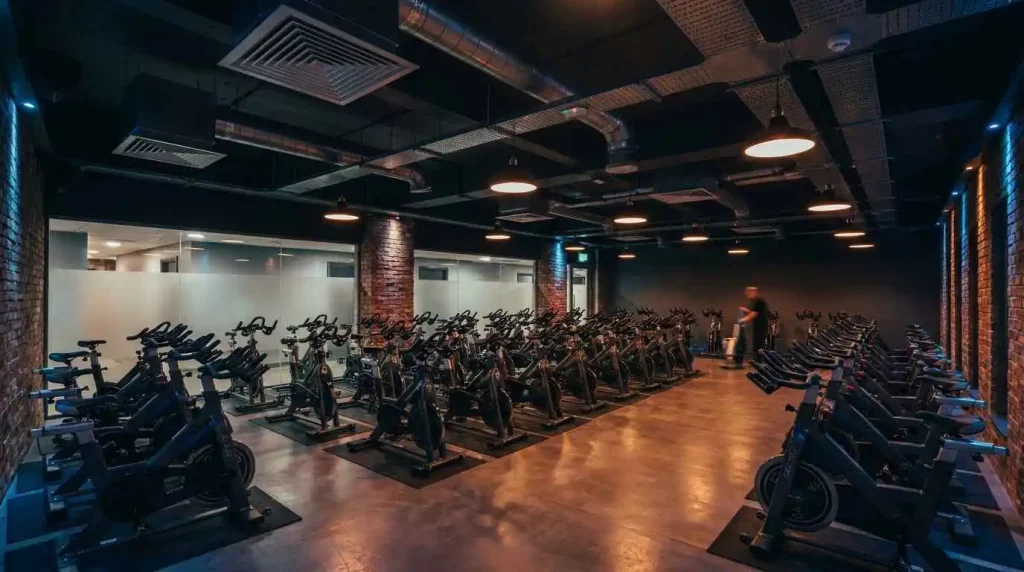
We were asked to carry out indoor air quality testing for gyms at an independent fitness studio in the West Midlands, where members had been complaining of headaches during evening classes and staff had raised concerns about the spin studio in particular.
Monitoring across a full week showed the main gym floor performed reasonably well, but CO₂ in the windowless spin studio climbed past 2,400 ppm within twenty minutes of a class starting and stayed there.
Airflow measurements confirmed the studio’s supply had been reduced during an earlier refurbishment and never rebalanced. PM2.5 was also elevated in the free weights area, tracking closely with chalk use.
The fixes were straightforward once the cause was clear: rebalancing the ventilation to restore supply to the studio, capping class sizes at a level the airflow could actually support, moving to a low VOC cleaning product, and switching to liquid chalk. Follow up monitoring showed peak CO₂ down to around 1,100 ppm. The complaints stopped.
The point is that the problem wasn’t obvious from inside the building it needed measuring to find.
What it costs and how long it takes
For a single site gym, a straightforward indoor air quality survey typically costs in the region of £900 to £2,500, depending on how many areas are tested and how long the monitoring runs. Larger leisure centres with pools, cafés and multiple studios cost more, as the survey has to cover several distinct environments.
Monitoring usually runs for 24 hours to a week to capture both peak and quiet periods, with the report following one to two weeks later. If you need continuous, long term data rather than a snapshot, ongoing air quality monitoring is often the better option it shows how the building performs across seasons rather than one week in isolation.
New gym or major fit-out? Test before you open
If you’re building a new gym or doing a significant refurbishment, testing at completion is worth doing before members arrive.
New flooring, adhesives, paint and equipment all off gas VOCs and formaldehyde most heavily in the first weeks after installation.
Post-construction testing also matters if you’re pursuing BREEAM certification the Hea 02 credit requires indoor air quality testing after construction and before occupation.
Getting this planned in early is far cheaper than retrofitting a fix once the building’s finished. Our indoor air quality services cover both BREEAM testing and general post-construction surveys.
How to fix what testing finds
Most problems come down to three levers, in this order.
Ventilation first. Check the system is actually running and correctly balanced as in the case above, refurbishments frequently leave rooms under supplied. Increase fresh air during peak hours, and open windows where it’s safe and the outdoor air is clean.
Filtration second. Higher grade filters in your HVAC will capture more fine particles. Portable HEPA units help in busy enclosed studios. Avoid anything that deliberately generates ozone it creates secondary pollutants rather than solving the problem.
Then behaviour and products. Cap class sizes to what the room can support. Switch to low VOC cleaning products and train staff to spray onto cloths rather than into the air. Manage chalk with liquid alternatives or better extraction. Keep on top of floor cleaning, since a lot of gym particulate is simply dust being re-suspended.
How FreshBreeze can help
We carry out indoor air quality surveys for gyms, leisure centres and health clubs across London, Birmingham and Manchester.
Every survey is timed around your actual peak hours, uses calibrated equipment, and comes with a easy language report that tells you what to fix first rather than just handing you a spreadsheet.
If you’re at the design or planning stage for a new facility, it’s also worth looking at how the wider development is assessed our guide to air quality assessments for planning covers what’s required before permission is granted.
Conclusion
Gyms are built around the idea of getting healthier, which makes poor indoor air a genuine problem for the business as well as the members. The reassuring thing is that most issues turn out to be fixable an under supplied studio, a cleaning product, a class size the ventilation was never designed for.
But you can’t fix what you haven’t measured, and the busiest hour of your week is exactly when a building is least likely to be coping.
A properly timed survey tells you where you actually stand, and usually costs far less than one month of lost memberships.
Frequently Asked Questions
It’s a professional survey that measures CO₂, particulate matter, VOCs, temperature and humidity across a gym during real operating conditions, then compares the results against recognised guideline values to identify what needs fixing.
Testing itself isn’t specifically mandated, but the Workplace (Health, Safety and Welfare) Regulations 1992 require effective ventilation in every workplace. Testing is how you demonstrate you’re meeting that duty.
Typically £900 to £2,500 for a single site gym, depending on the number of areas surveyed and the monitoring duration. Larger leisure centres with pools and kitchens cost more.
Monitoring usually runs from 24 hours up to a week to capture peak and off-peak conditions. The report follows one to two weeks after.
Aim to stay below 1,000 ppm during occupancy. Readings consistently above 1,500 ppm indicate the ventilation isn’t keeping pace with how many people are in the room.
A consumer monitor is useful for spotting a problem, but it won’t measure airflow rates, won’t be calibrated to a traceable standard, and won’t produce a report you can rely on for compliance or insurance purposes.
Annually is a sensible baseline for most sites, plus after any refurbishment, ventilation work, or significant change in opening hours or class sizes.

